
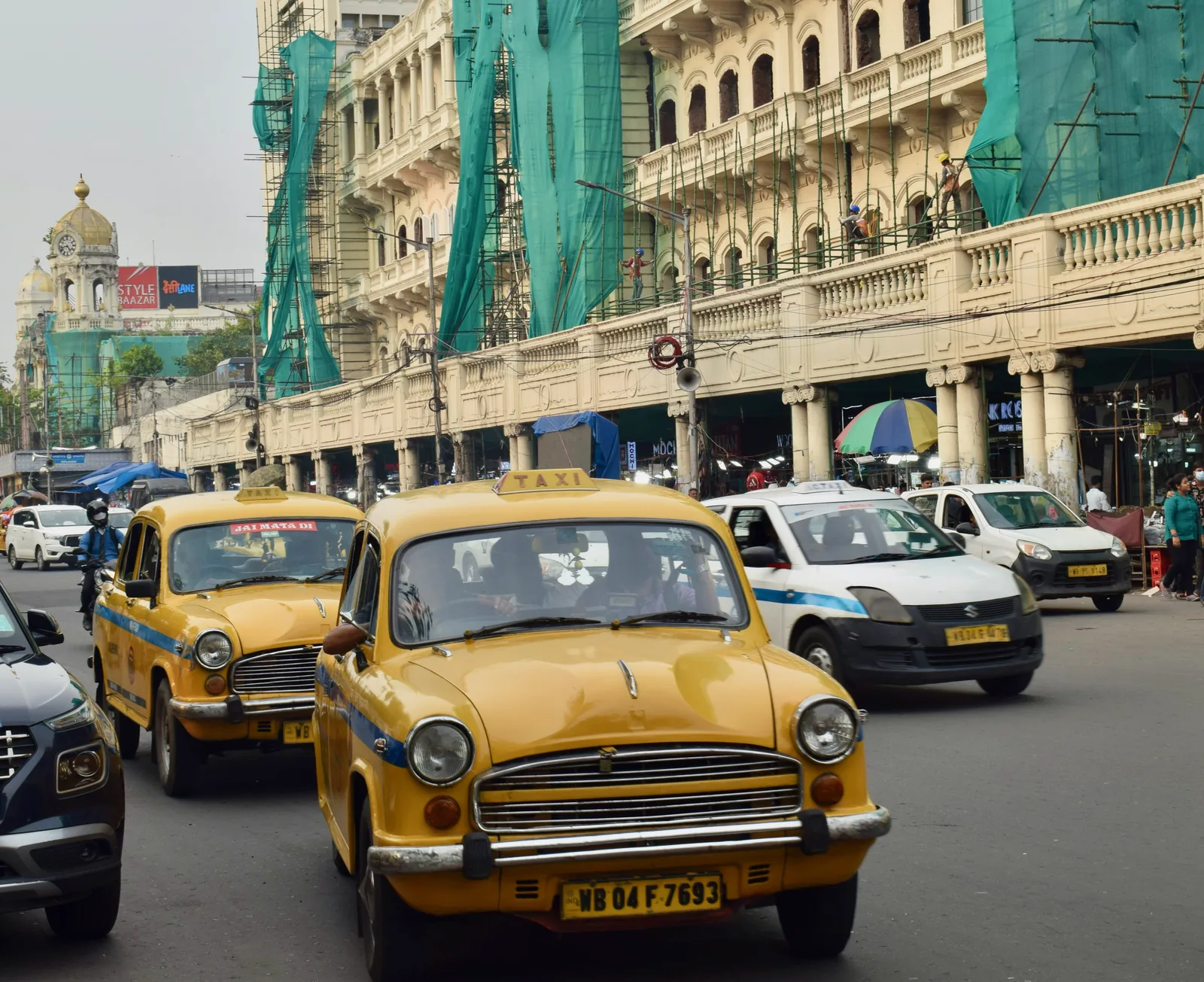
It's parked at an angle outside the old Metropolitan Building, nose into the kerb, driver asleep across the front seat with one foot propped on the open window frame. The paint has gone matte in patches where the sun gets it worst, and the chrome bumper carries a few honest dents. Nobody would call it elegant. But the shape — that rounded, slightly pompous British silhouette, built nowhere else in the world anymore — is instantly, unmistakably Kolkata. For six decades, if you needed a taxi in this city, this was the only shape it came in.
A British Design, Built Eighteen Kilometres from Kolkata
The car itself predates the taxi trade by four years. Hindustan Motors set up its factory in Uttarpara, on the Hooghly's western bank, in 1948, and in 1958 began building the Ambassador — a close copy of the 1956 Morris Oxford Series III, designed by Sir Alexander Issigonis, the same British engineer behind the Mini and the Morris Minor. It wasn't built for taxis at all; it was built as a respectable family car for a newly independent India. The Calcutta Taxi Association had other plans for it by 1962, and the car never really went back to being just a family saloon in this city again.
Sturdy, Spacious, and Yellow for a Reason
The choice made practical sense before it made any romantic one. The Ambassador's heavy chassis and high ground clearance suited roads that flooded every monsoon without fail, and its boxy body gave passengers a back seat with genuine legroom — a comfort middle-class Kolkata, mostly without private cars of its own, came to expect from a taxi ride rather than a luxury. The yellow paint was a civic decision, not an aesthetic one: easiest colour to spot in traffic, easiest to spot at night, and a taxi you could flag down from fifty metres away without squinting.
For much of the car's early decades on the road, the trade itself had a specific reputation attached to it. Sikh drivers dominated the profession through the early 1990s and were known, specifically, for running the meter honestly and taking the shortest route rather than the longest — a reliability that mattered enough to Kolkata's middle class that people would wait for a metered Ambassador rather than haggle with something cheaper.
A taxi you could trust to run its own meter honestly was, in a city that argues about almost everything, oddly uncontroversial.
The Car Satyajit Ray Kept Filming
The Ambassador's status outgrew the taxi trade fairly quickly. Satyajit Ray and Aparna Sen both returned to it on camera often enough that the yellow taxi became cinematic shorthand for the city itself — a late-night ride through empty streets standing in, more than once, for romance, uncertainty, or simply urban Calcutta being Calcutta. Decades of Kolkata childhoods include a first ride in the back seat of one of these, windows down, vinyl seats hot from the sun, a meter ticking in Bengali-accented rupees and paise that stopped being real currency long before the car itself stopped running.
The Factory Closed First. The Taxis Kept Going.
What makes the Ambassador's decline unusual is the order it happened in. Hindustan Motors built its last Ambassador on May 24, 2014 — after that date, there would never be another new one, anywhere, ever. And yet Kolkata's yellow taxi fleet carried on for another decade on nothing but surviving stock and the mechanics who knew how to keep fifty-year-old parts running. The fleet held at over 20,000 cars before the pandemic; drivers who sold up or changed trades during the lockdowns largely never came back, and the fleet has not recovered since. By late 2024 it had fallen to roughly 7,000. On November 25, 2024, the state transport department confirmed that close to 4,500 of those remaining taxis would be retired by the end of 2025, aged out under the standard 15-year limit on commercial vehicles — not because the cars had failed, in most cases, but simply because the clock on their paperwork had run out.
Every Ambassador retired this way is retired for good, in a way that wasn't true for most ageing taxi fleets elsewhere — there is no factory left to build a replacement chassis, no new unit coming down a line in Uttarpara to take the old one's place. What replaces it on Kolkata's streets is a newer blue-and-white cab, or an app on a passenger's phone calling something else entirely. The yellow Ambassador isn't being phased out into a newer version of itself. It's simply running out, one odometer at a time, with no way to make another.
A ride in one of the last yellow Ambassadors, traffic and all, is still part of the real Kolkata we show you on a private tour.
See the North Kolkata Tour →