
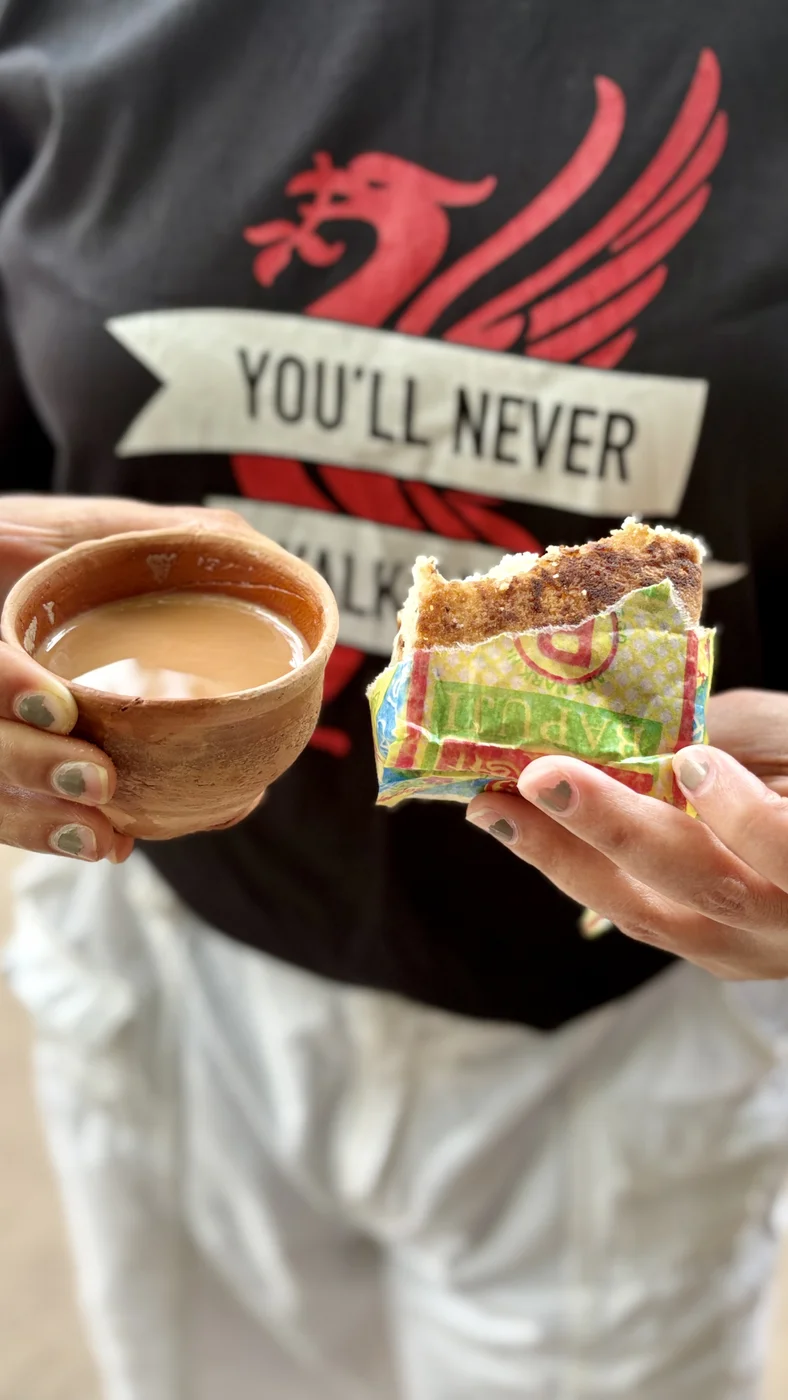
The wrapper is the first thing you recognise — cheap, waxy paper printed in a loud checkerboard of red, yellow and green, the kind of packaging that hasn't been redesigned because nobody ever saw a reason to. Inside it, a square of pale sponge studded with flecks of tutti frutti and the odd translucent cube of petha, torn in half and already a little crumbled from the walk over from the stall. In one hand, this. In the other, a clay cup of cha. This is not a dessert. It is a fact of life that happens to be sweet.
Named After the Father of the Nation, by Accident of Timing
The cake dates to 1973, when an industrialist named Alokesh Jana set up a small confectionery unit — New Howrah Bakery — in Pallabpukur, Howrah, with a single, unambitious goal: a cake cheap and filling enough that nobody in Bengal would think twice about buying one. It launched at sixty paise. The Congress government held power in the state at the time, and in that political climate, Jana named his cake after Mahatma Gandhi — Bapuji, 'revered father,' the affectionate name millions of Indians already used for him. There was no grand unveiling, no campaign. A cheap cake simply inherited a very large name, and the name stuck harder than the business plan ever needed it to.
Tutti Frutti, Petha, and Nothing Else to Prove
There is no version of Bapuji Cake trying to be a better cake. It is a plain sponge, sweetened simply, dotted with cheap, candy-bright tutti frutti and small translucent pieces of petha — ash-gourd candy, more texture than flavour, there mainly to give the sponge something to hold onto. It was never meant to compete with a bakery patisserie, and it has never once tried to. Its entire design brief, from 1973 onward, has been to cost almost nothing and taste exactly the same every single time.
The wrapper never changed because the cake never needed it to. Consistency was the whole product.
For decades it travelled through the places a cheap, shelf-stable snack naturally ends up: tea stalls on every second corner, small grocery counters, hawkers working the aisles of local trains calling out its name over the rattle of the tracks. For an enormous number of Bengali schoolchildren through the '80s and '90s, a slice of Bapuji Cake was a fixture of the tiffin box — the thing you traded a biscuit for, the thing that meant the school day had reached its good part.
Still Family-Run, Still Eight Rupees
New Howrah Bakery never stopped being a family business. Alokesh Jana's sons, Amitabha and Animesh, now run what their father started, and at its peak the company has been reported to sell over a lakh cakes a day — a volume that depends entirely on the price staying low enough for a tea-stall purchase to feel like no decision at all. It has risen since 1973, from sixty paise to roughly three rupees, then five, and now around eight — inflation doing what it does, even to a cake built around the idea of costing almost nothing.
What has changed is less the cake than what's around it. Tea stalls have given way, in some neighbourhoods, to coffee chains; school tiffins increasingly carry something with a brand name and a mascot. Bapuji Cake hasn't disappeared, but it has receded — easier to find at a railway platform or an old-fashioned grocery than in the aisles of a new supermarket, which suits a product that was never trying to modernise in the first place.
What keeps it alive now is less hunger than memory. Nobody buys Bapuji Cake because there's nothing better available — plenty is. People buy it, when they find it, because the first bite is still exactly the one they remember: the same sponge, the same too-sweet tutti frutti, the same cheap paper, the same eight rupees standing in for every rupee it ever cost. In a city fond of reminding itself what it used to be, this is one of the few reminders you can actually eat.
Tea stalls, old bakeries, and the small edible memories of this city are part of what we show you on a private walk through North Kolkata.
See the North Kolkata Tour →