
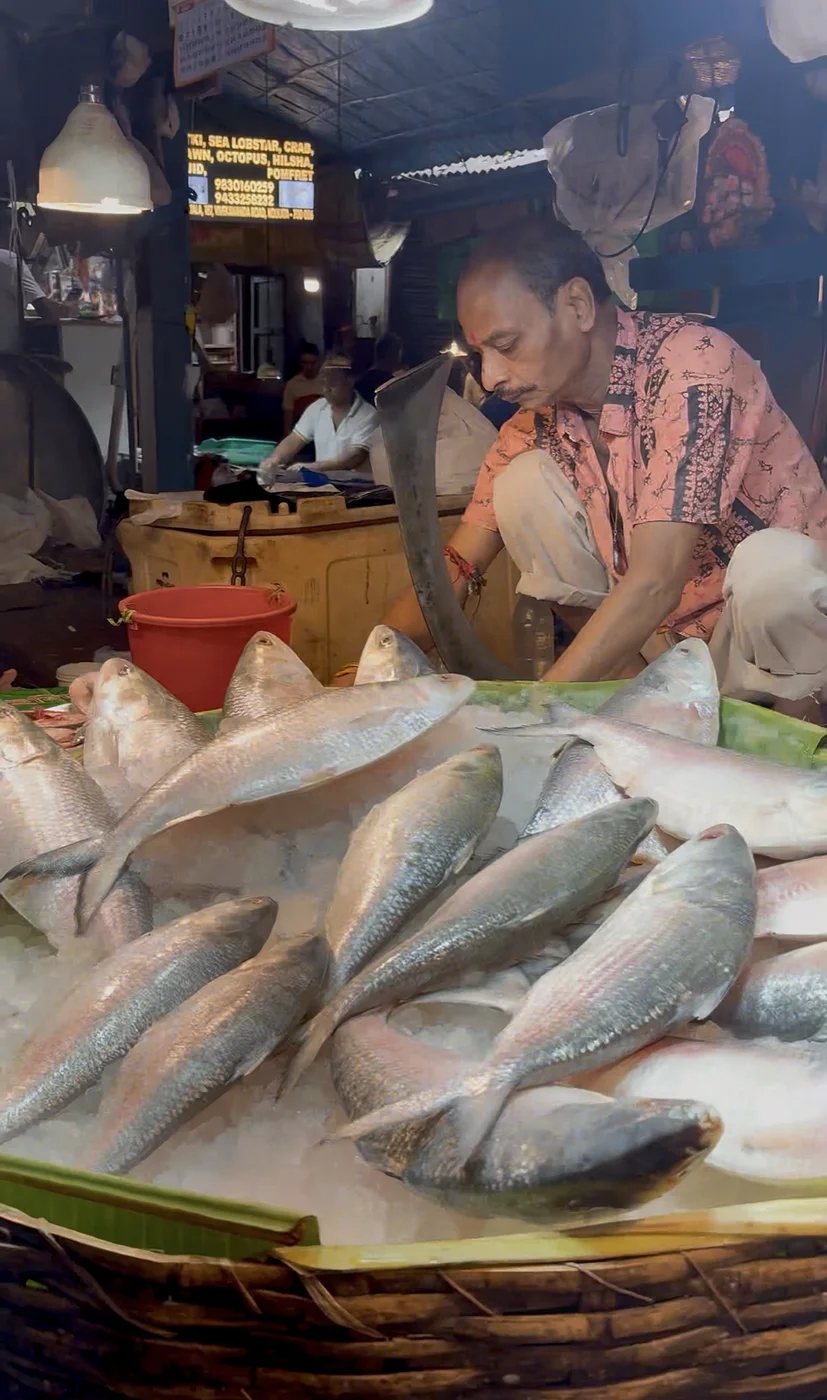
The man in the pink shirt doesn't look up from the fish. His bonti — a long curved blade fixed to a wooden base, worked with the foot while both hands stay free — rests mid-motion, and a dozen fresh hilsa lie fanned out on crushed ice in front of him, scales catching the bare bulb overhead. A customer leans in, lifts one fish by the gill without asking permission, checks the colour underneath, sets it back down, and picks up another. Nobody has said a word about price yet. In a Bengali bajar, the negotiation always starts with the fish, never the fisherman.
A Morning Errand That Was Never Just an Errand
For generations, buying fish was a job that belonged specifically to the men of a Bengali household — not cooking, not cleaning, but bajar kora, 'doing the market,' done first thing after the morning cup of tea and before the day's heat set in. Popular art, cinema and a hundred family photographs have fixed the image: a man in a white dhoti and kurta walking home with a jute bag, a fish tail or a crab claw visibly escaping the top of it, an expression that promised a good lunch. The ritual mattered as much as the fish — a man who chose well was, in some quiet domestic sense, taken seriously.
The Gill Test
Freshness in a Bengali fish market is not taken on the seller's word. A buyer lifts the gill flap of a rohu or katla and looks for a deep, wet red — pale or brownish gills mean the fish has been sitting too long, whatever the seller claims. Eyes are checked next: clear and slightly bulging is fresh, clouded or sunken is not. None of this is explained to a first-time visitor; it's assumed knowledge, passed down the way a recipe is, by watching someone do it a few hundred times before you're allowed to do it yourself.
The haggling isn't hostility — it's closer to a formality both sides enjoy. Everyone already knows roughly where the price will land; the conversation is the point.
Five Markets, Five Different Mornings
Kolkata doesn't have one fish market — it has dozens, each with its own character. Gariahat Market, at the busy south Kolkata crossing of the same name, is where the serious hilsa money changes hands in season, regulars bargaining hard over fish that can cost more per kilo than meat. Maniktala Fish Market, over a century old and still marked by its small clock tower, deals mainly in freshwater varieties — rohu, katla, koi, magur — stacked in a maze of stalls that locals navigate from memory. In Paikpara, the smaller neighbourhood market known as Ashu Babur Bajar specialises in what a bigger market wouldn't bother with: small river prawns, parshe, pabda — fish meant for a specific family recipe, not mass appeal.
New Market, in the city centre on Lindsay Street, keeps its fish and meat section inside a Victorian Gothic complex built for an entirely different century, its old cold-storage rooms still doing their original job on bhetki and export-grade prawns. And before any of these open for the day's regular trade, the Howrah Wholesale Market near the station has already been running for hours — one of the largest wholesale fish operations in Asia, where buying starts around three in the morning and most of the city's smaller sellers stock up before sunrise.
Ilish: The Fish That Gets Its Own Season
No fish in Bengal is spoken of quite like hilsa — ilish. When it's in season, prices climb, arguments about which river produced the best catch get genuinely heated, and a good piece of ilish, fried simply or cooked in mustard gravy, becomes the measure of whether a particular monsoon meal succeeded. It is not the most expensive fish because it is rare; it is expensive because, for a Bengali household, there is no acceptable substitute when it's wanted.
What's changed is less the ritual than who performs it. Fish increasingly arrives by phone order and home delivery now, picked from a photo rather than lifted by the gill, and the generational certainty that the bajar was a man's job alone has loosened considerably. But walk into Maniktala or Gariahat on any ordinary morning and the old choreography is still fully intact — the lifted gill, the unhurried argument, the fish wrapped and handed over like something that matters, because in this city, it still does.
A working fish market, chosen and bargained over the traditional way, is part of the real Kolkata we show you on a private tour.
See the North Kolkata Tour →