
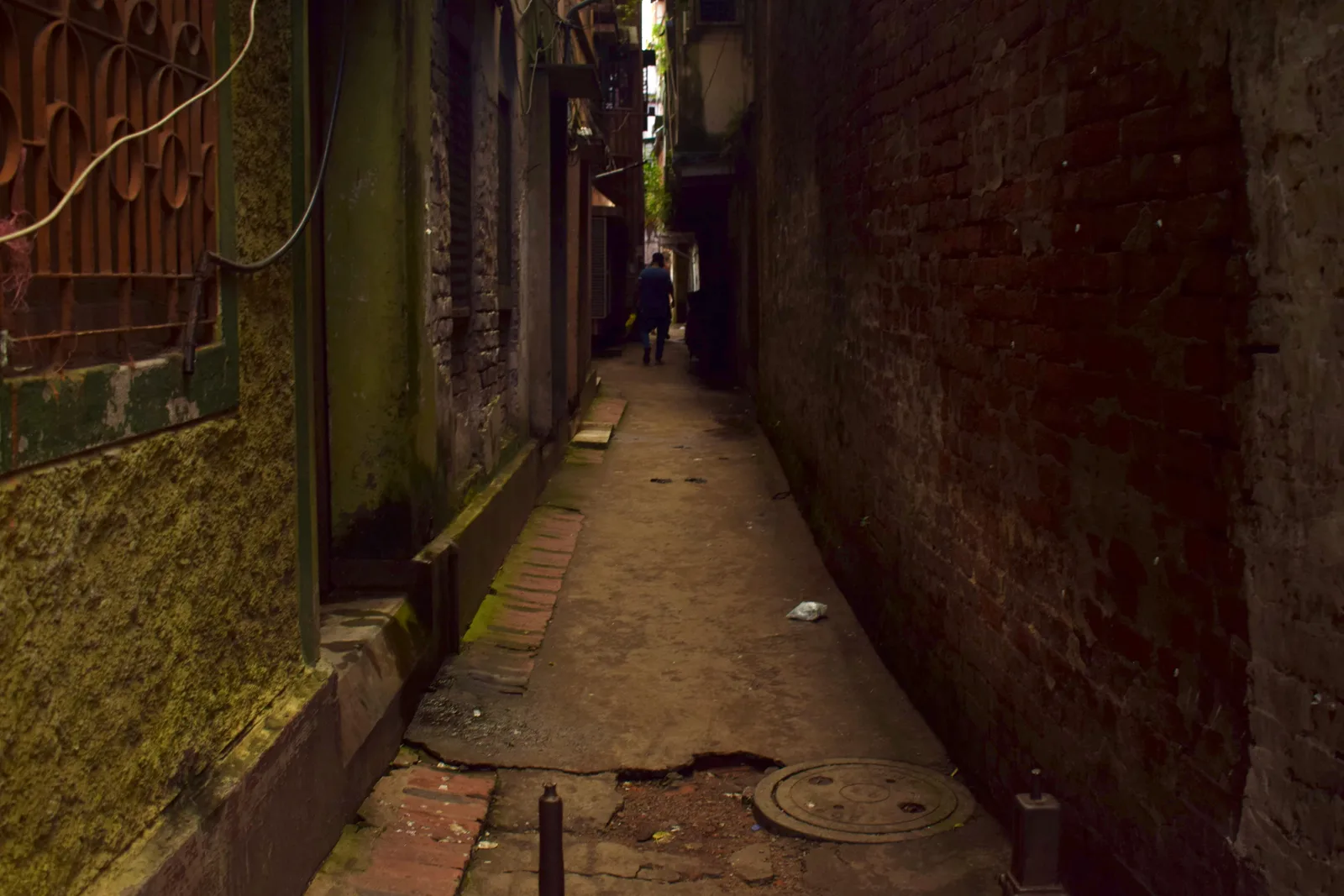
The shop hasn't closed, exactly — the shutter is down to waist height, and the owner is visible underneath it, stretched out on a wooden bench with one arm over his eyes. A cat has claimed the brass weighing scale as a bed. Somewhere above, a ceiling fan turns at the speed of something that has given up trying to cool anyone and is now just making noise for company. The lane itself has gone quiet in a way it never is at any other hour — no vendor's call, no rickshaw bell, just heat, and the particular stillness of a city that has, without ever voting on it, agreed to stop.
A Sleep With Its Own Name
Bengalis call it dupur ghum — afternoon sleep — though the more affectionate household term is bhat-ghum, rice-sleep, which gets closer to the actual cause. Lunch in a Bengali home is rice, not a side dish to something else: rice with dal, a vegetable, fish or an egg, finished with a spoon of ghee or a slice of lime. Eaten at the day's hottest hour, it does to the body exactly what a large carbohydrate load and a Kolkata afternoon are designed to do together. The eyelids do not so much grow heavy as simply stop negotiating.
A Childhood Ritual, Not a Lazy Habit
For Bengali children of a certain generation, dupur ghum was not optional in the way a nap is optional elsewhere. School ends at lunchtime; a plate is put down the moment the uniform comes off; and within the hour, a mother or grandmother is standing in the doorway with the specific tone reserved for this one instruction — শুয়ে পড়ো, lie down now. Two hours were simply subtracted from the day and handed back to the body. Negotiating out of it was rarely an option worth attempting twice.
The nap was never framed as rest you were owed. It was simply what the afternoon required of you, the same way the evening required you to bathe.
What made the ritual bearable, even something to look forward to, was who was usually in the room for it. A grandmother's dupur ghum came with a story attached — pourani kahini, old tales of kings, ghosts, and clever animals, often drawn consciously or not from Thakurmar Jhuli, the collection of Bengali folk tales compiled in 1907 by Dakshinaranjan Mitra Majumder from stories he gathered village by village in what is now Bangladesh. Rabindranath Tagore wrote its introduction; three thousand copies sold within the first week. More than a century later, its stories are still what gets murmured over a child by lamplight, or by the thin afternoon sun through a half-closed shutter, until the sentence trails off into actual sleep.
A City That Still Half-Believes In It
The siesta is hardly unique to Bengal — heat and a heavy midday meal produce the same drowsiness from Andalusia to the Philippines. What distinguishes Kolkata is how long the city has resisted apologising for it. In the glass-fronted offices of Salt Lake and New Town, dupur ghum has mostly lost the argument to air-conditioning and shift schedules that don't pause for anyone. But step a few streets back — into Shyambazar, Bowbazar, the lanes around a neighbourhood para — and the old agreement still mostly holds. Retired men on a veranda, a tailor between customers, a grandmother with a child already half asleep against her arm: the city's working hours have changed around them, but the hour after lunch has not entirely stopped belonging to rest.
It would be easy to call dupur ghum a relic, a habit the next generation is gently leaving behind along with the joint family that enforced it. That's probably true in the new apartment towers. But in the older lanes, on a hot afternoon, you can still watch an entire street slow its pulse in near-unison — not because anyone organised it, but because this is simply what the body has always done here at this hour, and the city, unlike most, has never fully insisted otherwise.
North Kolkata's quieter hours are part of what we show you — the city's actual rhythm, not just its sights, on a private guided walk.
See the North Kolkata Tour →