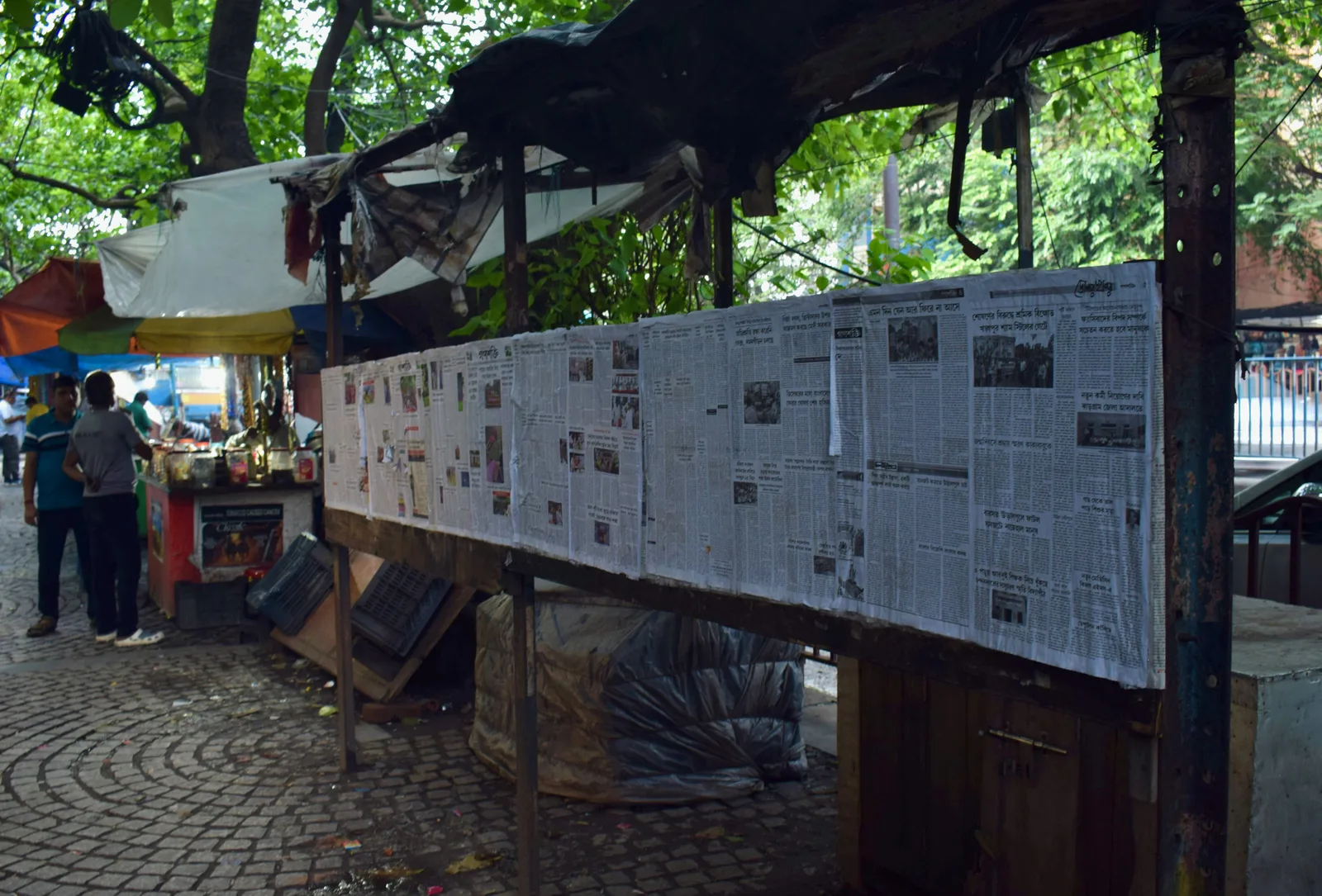
The stall itself sells cigarettes, matches, perhaps a few loose biscuits — nothing that explains the small crowd gathered in front of it at eight in the morning. The explanation is pinned to the wall above the counter: three or four newspapers, clipped or taped flat so the wind can't take them, open to whichever page the last reader left them on. A man in a lungi reads the sports page standing up, hands clasped behind his back. Another leans in from the side to check the headline, says something to nobody in particular, and moves on. Nobody has bought anything. Nobody is expected to.
A City That Built Reading Rooms Before It Built Much Else
The wall-mounted newspaper is the most casual, least organised version of a habit Kolkata formalised a long time ago. By the late nineteenth century the city was filling up with para libraries — neighbourhood reading rooms, usually a single room with a long table, newspapers held down by a brass paperweight, and a membership register that cost next to nothing to join. The Calcutta Reading Rooms and Literary Institute opened in 1872, followed by the Baghbazar Reading Room in 1883, the Chaitanya Library and the Beadon Square Literary Club in 1889, and the Albert Library in 1890 — a wave of small, specific, locally funded rooms that had nothing to do with a government budget and everything to do with a neighbourhood deciding it wanted one.
Tagore, a Freedom Movement, and a Library Boom
The spread wasn't accidental. In the 1920s the reading-room movement got an explicit push from Deshbandhu Chittaranjan Das and Rabindranath Tagore, both of whom treated access to a newspaper and a shelf of books as closer to a civic right than a leisure pursuit. Labour unions, Left student groups, and — after 1947 — refugee resettlement committees all adopted the same model for the same reason: a room with newspapers in it was cheap to run, impossible to object to, and did more for a neighbourhood's sense of itself than almost anything else the money could have bought. By 1942 the city and its suburbs counted some 295 such libraries, 222 of them exactly this kind of small, walkable, locally run room rather than anything grand.
Nobody was trying to build a national library system. They were trying to make sure the newspaper reached everyone on the street, not just whoever could afford to buy it.
Is This Actually Unique to Kolkata?
It's a fair question, and the honest answer is: not entirely. A tea stall with a newspaper on the counter is a familiar sight across India, and the morning ritual of reading someone else's copy, for free, while the tea is poured is common enough that it isn't really a Kolkata invention. What does appear to set Kolkata apart is less the informal version — the stall, the pinned-up page — than how far the city took the formal one. Very few Indian cities can point to a documented, century-old network of neighbourhood reading rooms, each with its own founding date, its own building, and an explicit political movement behind its growth. The wall-mounted newspaper outside a stall and the para library a few streets away aren't separate customs; they're the same impulse — free, shared, unhurried access to the news — at two very different scales.
That impulse has thinned out since the 1990s. Liberalisation, the arrival of the smartphone, shrinking municipal grants, and real-estate pressure on old buildings have closed more para libraries than have opened in the last three decades. It isn't all retreat, though — Das Gupta & Co, the 140-year-old bookshop on College Street, reopened its own reading room to the public in 2025, a small, deliberate echo of the exact tradition it's describing.
The newspaper pinned to a stall wall will never be written up in a civic history the way a reading room with a founding plaque might be. But it's arguably the purer version of the same idea — no membership register, no building, just a single copy of the day's paper and an unspoken agreement that everyone standing nearby gets to read it before it comes down. Walk past one on an ordinary morning and you're looking at the same instinct that opened 295 libraries a century ago, reduced to its smallest and most durable form.
The small daily rituals of a neighbourhood — the newspaper wall included — are part of what we show you on a private walk through North Kolkata.
See the North Kolkata Tour →