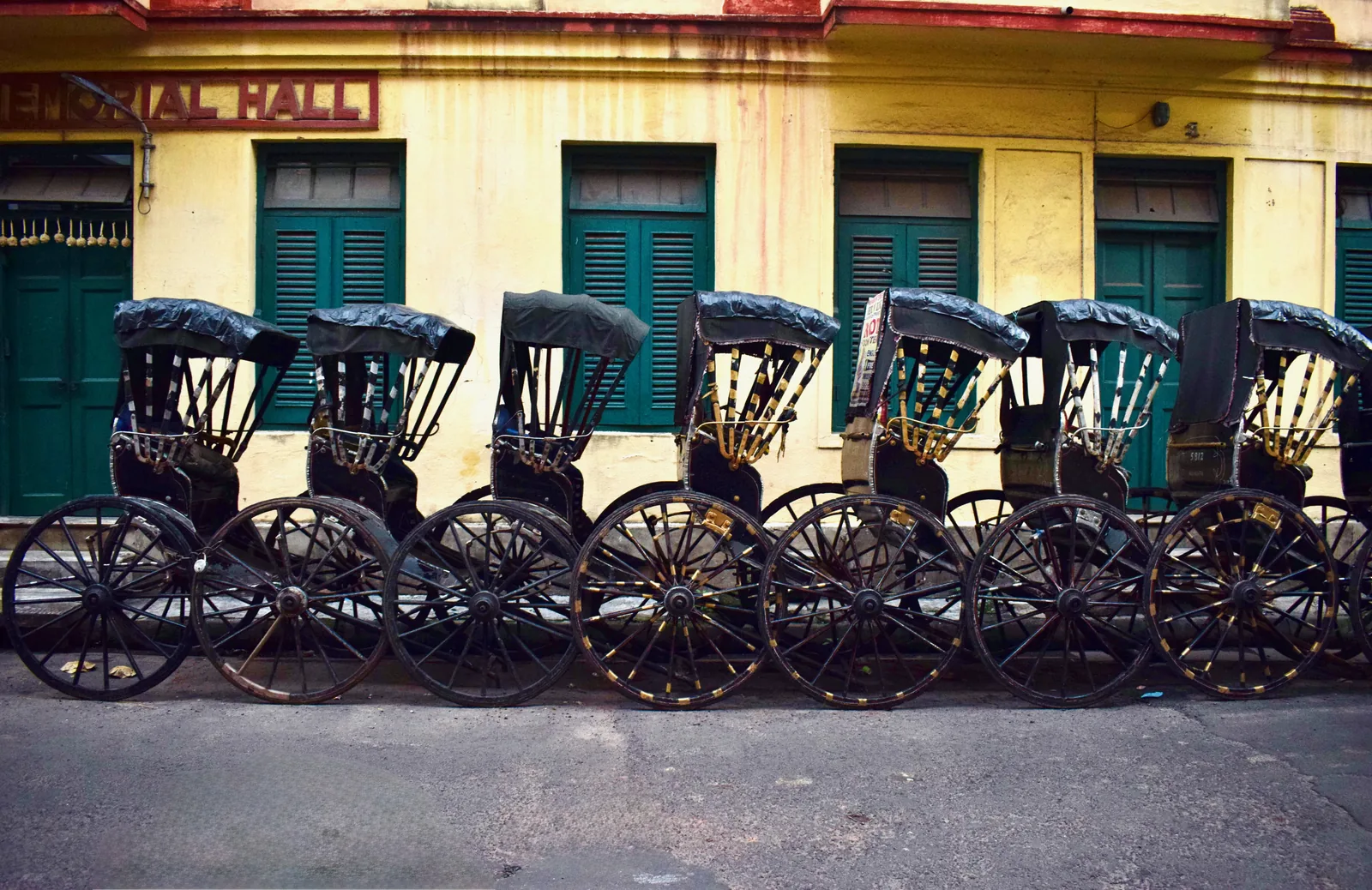
The rain has turned the lane into a shallow river, ankle-deep and the colour of tea. A bus has stalled two streets over. An auto-rickshaw sits beached at the junction, its driver standing beside it with the particular stillness of a man who knows better than to try the engine again. And then, cutting through the flood at a steady trot, barefoot, a rickshaw puller — rope-thin arms locked straight, the shafts of his rickshaw raised like the poles of a sedan chair, a schoolbag and a child riding dry above the waterline. He is, at this moment, the only form of transport in Kolkata that still works.
Brought by Immigrants, Kept by Necessity
The hand-pulled rickshaw did not originate in India. It arrived with Chinese immigrants settling in nineteenth-century Calcutta, a city already absorbing trades and people from everywhere the port touched. What began as an informal, unlicensed way of moving goods and passengers through narrow lanes was eventually brought under municipal law by the Calcutta Hackney-Carriage Act of 1919, which formally recognised the two-wheeled, man-pulled carriage as hired public transport — a status no other Indian city ever extended to it, and one Kolkata alone has never fully withdrawn.
The Only Vehicle the Monsoon Can't Stop
For most of the year, the hand-pulled rickshaw survives on short errands — a school run, a grocery trip, an elderly resident who cannot manage the walk to the main road. But it is during the monsoon that its usefulness stops being quaint and becomes simply practical. North Kolkata's older lanes flood easily and often; autos stall, cycles are useless, cars don't fit. A rickshaw puller, standing above the waterline on legs that know every pothole underneath, can go where nothing with an engine can follow.
No fuel to run out of, no engine to flood — just a man, two wheels, and a knowledge of the lane that no map has ever recorded.
That reliability has a cost structure most passengers never think about. Very few pullers own the rickshaw between their hands. Most rent from a sardar — an owner who operates a khatal, a depot where a fleet of rickshaws is stored, maintained, and let out by the day. The arrangement suits pullers who work seasonally, returning to villages in Bihar, Jharkhand, Odisha, and Uttar Pradesh for the agricultural calendar and coming back to Kolkata when the fields are done with them. After paying the sardar and feeding himself, what a puller keeps at the end of a long day is modest — and most of it is sent home before it is spent on anything else.
Banned on Paper, Still on the Street
In 2006, the state government moved to end the trade outright, framing the image of one human being hauling another through the street as incompatible with the dignity a modern city owed its workers. The legislation passed. It was never meaningfully enforced. No new licences have been issued in decades, which means every rickshaw still legally pulling a passenger today is operating on a permit older than many of its passengers — but the ban that was meant to retire the trade instead just froze it, leaving thousands of unlicensed pullers to keep working in the gap between the law and its enforcement.
The pullers themselves have, at various points, resisted the ban as forcefully as reformers pushed for it — not because the work is dignified, but because no replacement income was ever offered alongside the prohibition. It is a rare dispute in which both sides can be right: the image is hard to defend, and the alternative, for a man with no land and no other trade, is harder still.
The trade is thinning anyway, ban or no ban. App-based transport reaches further into the lanes every year; sons of pullers, by and large, do not become pullers themselves. What remains is a shrinking number of older men, mostly from Bihar, who know this version of Kolkata — its floods, its shortcuts, its willingness to still need them — better than the city is willing to admit.
See the lanes these rickshaws still run through — North Kolkata's daily life, not just its monuments, on a private guided walk.
See the North Kolkata Tour →