
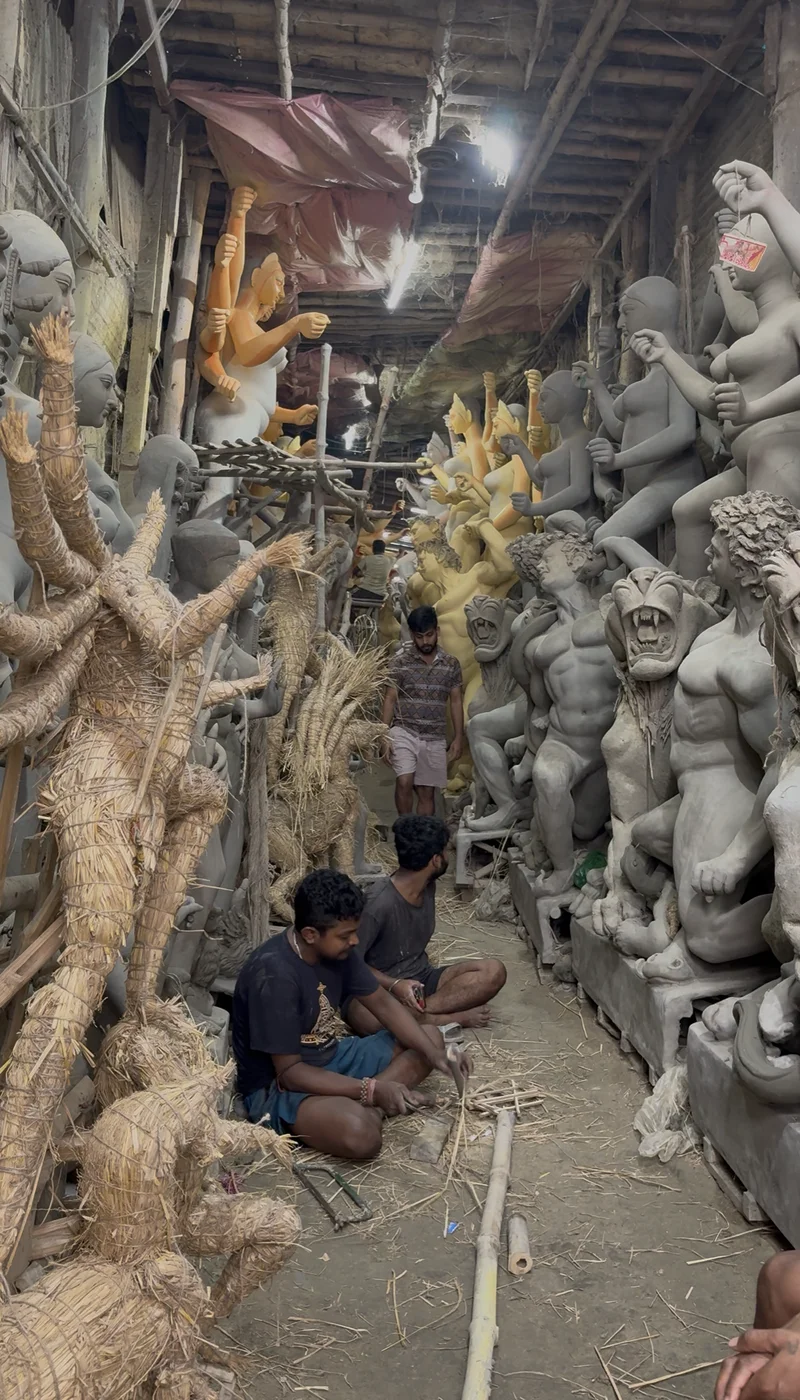
The lane is barely wide enough for two people to pass, and every inch of it not occupied by a body is occupied by a god. Grey clay torsos lean against bamboo scaffolding, still faceless. A straw skeleton, bound tight with jute rope, waits its turn for the first coat of mud. Further down, a finished figure already wears gold paint and an expression — ten arms raised, a demon crumpling beneath one foot. Two men sit cross-legged on the ground between them, unhurried, binding more straw into the shape of a shoulder. Nobody looks up. This is not a performance for visitors. It is simply what this lane has done, every year, for roughly three hundred years.
Three Centuries of Imported Craftsmen
Kumartuli takes its name plainly — kumor, potter, and tuli, a small walkable quarter. The settlement dates to the seventeenth and eighteenth centuries, when artisans of the kumor caste began migrating into the growing city from Krishnanagar and Nabadwip, two towns in western Bengal already known for their modelling work. It wasn't entirely organic: the landowning families of North Kolkata, building their own household Durga Puja traditions, actively brought idol-makers in from those towns to sculpt for them. By the late nineteenth century — the era of Kolkata's horse-drawn trams — enough of those seasonal craftsmen had simply stayed on that Kumartuli stopped being a place potters visited and became a place they lived.
Four Handfuls of Earth
Every artisan guards a slightly different formula, but tradition holds that a true Durga idol needs four specific things mixed into its clay: river mud from the Hooghly, cow dung, residue from a cow's grinding stone, and — the one visitors are usually most surprised to learn — punya mati, soil gathered from directly outside a brothel in one of the city's nishiddho palli, the 'forbidden lanes.' Without it, the idol is traditionally considered incomplete.
One version of the story says a man leaves his virtue at a brothel's doorstep the moment he enters — so the earth there, strangely, is left holy. Another says the sex workers of the city once helped a leper bathe in the Ganga, not knowing he was Shiva in disguise, and were blessed for it. Either way, no handful of soil in Kumartuli is treated as more essential.
It is a tradition that sits a little uneasily with how the rest of the year treats the women who provide that soil — ostracised, rarely acknowledged — and Kumartuli artisans are generally matter-of-fact rather than sentimental about it. The soil is requested, given, and worked into the goddess's body without ceremony. For one month before Puja, a lane otherwise avoided becomes, briefly, necessary.
The Moment the Clay Becomes a Goddess
An idol can spend weeks as a body without being, in any meaningful sense, Durga. Layers of straw, then coarse clay, then a finer finishing coat, then paint — ten arms individually sculpted and fitted, weapons placed in each hand, a demon modelled separately and positioned underfoot. Through all of it, the face stays blank: two smooth ovals where the eyes should be. The final brushstroke — chokkhu daan, the 'donation of eyes' — is treated as a separate, almost sacred act, often reserved for the most senior artisan in a workshop. The moment the pupils are painted in is, by tradition, the moment a sculpture stops being clay and becomes the goddess herself. Everything before it is craft. That instant is considered something else.
Shipped to Paris, Made the Same Way
Kumartuli's trade stopped being purely local decades ago. Bengali communities in France, the UK, the USA and Germany now order idols from the same workshops that supply Kolkata's biggest pujas — some full-sized and shipped in sections, others deliberately sculpted small enough to travel as cabin luggage. The techniques don't change for export. The same straw, the same river clay, the same unhurried hands.
What's harder to export, or even to sustain locally, is the tradition's relationship with the river it depends on. Every year, more than fifteen thousand Durga idols go into the Hooghly during visarjan — immersion — and for decades that has meant tonnes of varnish, oil-based paint and synthetic colour going in with them; one government study from the 1990s put the figure at close to seventeen tonnes of varnish and oil and thirty-two tonnes of paint pigment annually, much of it later found to contain heavy metals. Kumartuli's own traditional materials — river clay, bamboo, straw, natural dye — were never the problem. The newer pressures toward cheaper synthetic paint and Plaster of Paris, driven by cost and demand rather than craft, are what the city's rivers have been absorbing instead.
Kumartuli persists anyway, in the particular way old crafts persist in Kolkata — not protected, not really modernised, just still standing because the demand for a hand-built goddess has never actually gone away. Walk the lane in August or September and you will find a neighbourhood working at a pace that has nothing to do with how fast the rest of the city moves, making, with mud and straw and borrowed soil, something that will be worshipped for five days and dissolved in a river a few days after that.
Kumartuli's working lanes are part of our North Kolkata walk, alongside the city's ghats, markets, and heritage mansions.
See the North Kolkata Tour →