
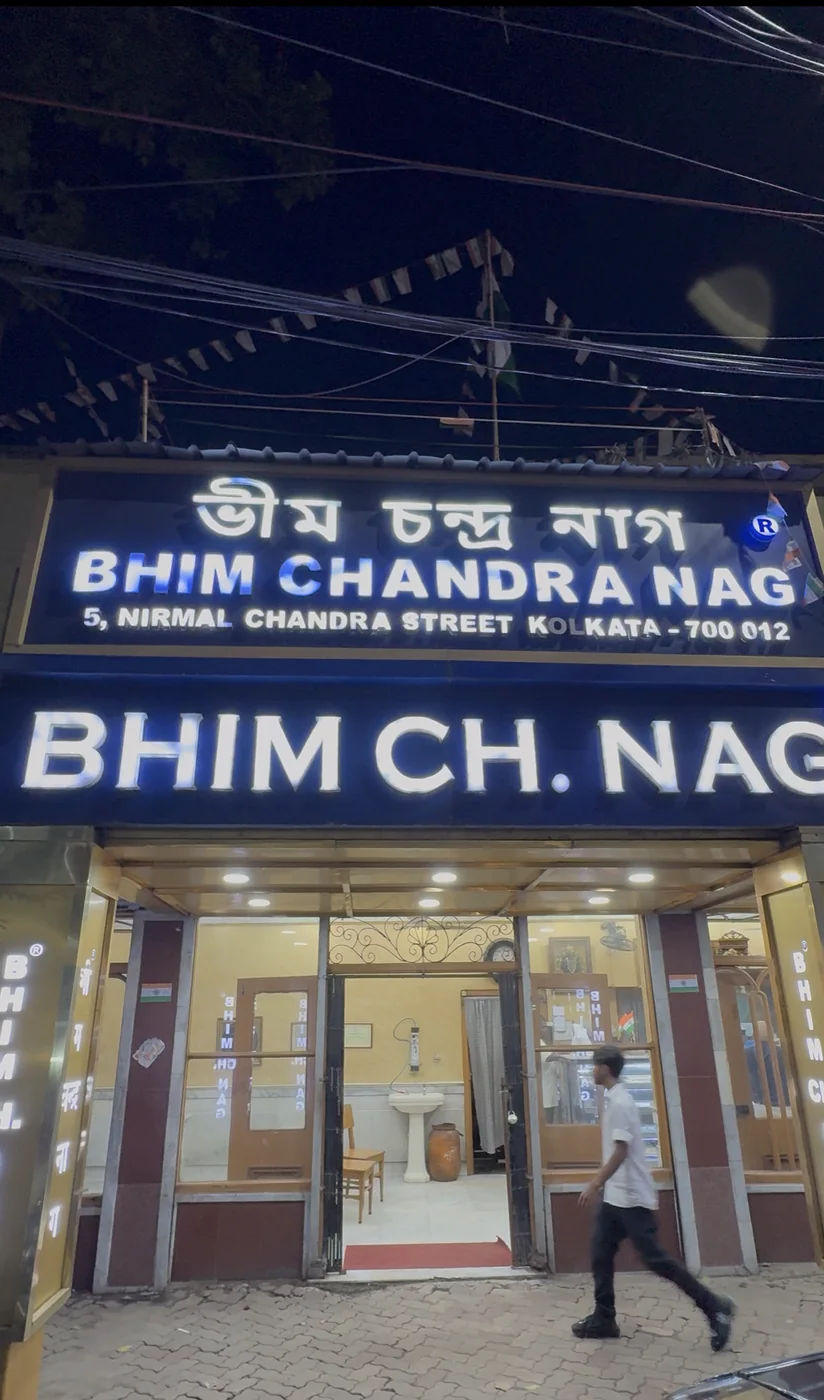
On the counter at Bhim Chandra Nag, the sandesh sit in neat rows, pale off-white and barely sweetened to look at, each one stamped with the faint ridged pattern of the wooden mould it was pressed into minutes earlier. No syrup pools underneath them. No sugar glaze catches the light the way it does two shelves over, on the rosogolla. You'd be forgiven, glancing quickly, for walking past. Pick one up anyway. Inside is a texture most people spend years not knowing Bengal is capable of — and behind the counter is a shop that has been getting it right since 1826.
Overshadowed by Its Own Family
Ask someone outside Bengal to name a Bengali sweet and you'll hear rosogolla almost every time, maybe misti doi second. Both deserve the reputation — a good rosogolla, spongy and barely sweet, soaked in light syrup, is one of the cleanest pleasures in Indian food, and misti doi, caramelised sweetened yoghurt set in a clay pot, keeps well enough to be sold at every sweet shop and roadside stall in the state. Sandesh, Bengal's third great sweet, rarely gets mentioned in the same breath — not because it's lesser, but because it was never built to travel.
Rosogolla ships in syrup, in a tin, for weeks. Misti doi sets in a sealed clay pot and holds for days. Sandesh is chhena — fresh paneer, kneaded while it's still warm — worked by hand into shape and eaten, ideally, within hours. There's no export-friendly version of a sweet whose entire appeal depends on freshness a courier can't preserve. That's the whole story of why it stayed comparatively obscure outside Bengal: it isn't a lesser sweet, it's simply a sweet that insists on being eaten where it's made.
Norom Pak, Kora Pak, and a Craft Most People Never See
What sandesh demands instead of syrup is skill, and Bengali confectioners have built an entire vocabulary around how precisely the chhena is cooked. Norom pak — 'soft cooked' — is kneaded with sugar and warmed only briefly, kept moist and faintly grainy; it's the softer, more popular style, but it doesn't keep. Kora pak is cooked considerably longer, often with khoya folded in, until it firms into a denser, drier sweet that lasts days rather than hours. Between those two poles sits an entire repertoire: kachagolla, barely cooked and intensely milky; jolbhora, a sandesh shell concealing a hidden pocket of liquid nolen gur that bursts the moment you bite in, a trick of construction that takes real practice to pull off without the shell cracking first.
A rosogolla is forgiving. A sandesh, done properly, is not — there's nowhere to hide a bad batch of chhena behind a bowl of syrup.
Bhim Chandra Nag: Two Centuries on the Same Street
Bhim Chandra Nag was set up in 1826 by Paran Chandra Nag on what was then Wellington Street in Bowbazar, North Kolkata — now renamed Nirmal Chandra Street, where the shop still stands, run by descendants of the same family two hundred years later. It takes its name from Paran Chandra's son, Bhim Chandra, who eventually took over the business and, by most accounts, is the reason the shop became a citywide institution rather than a neighbourhood confectioner.
The shop's most famous invention has nothing to do with sandesh at all. In 1858, Lady Canning — wife of Charles Canning, the Viceroy of India — asked Bhim Chandra Nag to create something special for her birthday. What he produced was a deep-fried chhena sweet soaked in sugar syrup, and the city, never one to let a good story go unembellished, named it after her: Ledikeni, 'Lady Canning,' a dessert that still outsells almost everything else on the shop's counter. A grandfather clock with Bengali numerals, reportedly gifted to the shop by a British patron named Thomas Cooke that same year, still stands inside — one of the few objects in the shop older than the Ledikeni itself.
The shop's sandesh is where its real reputation among connoisseurs lives, though — Ashubhog, Chhanar Sandesh, and Paradise Sandesh among the standing favourites, alongside a mishti doi served the traditional way, in a shallow clay bowl. Rani Rashmoni and Sri Ramakrishna Paramhansa are both said to have been regulars in the shop's earliest decades; Rabindranath Tagore and the jurist Sir Ashutosh Mukherjee followed later, and in more recent memory, Satyajit Ray and the cricketer Sourav Ganguly have both been counted among its loyal customers.
What's easy to miss about Bhim Chandra Nag, two hundred years in, is that none of this longevity depended on scale. The shop never franchised, never shipped its sandesh nationally, never chased the kind of fame that turned rosogolla into a sweet sold in tins from Delhi to London. It simply kept making sandesh the way sandesh has to be made — fresh, by hand, eaten the same day — on the same street it started on, for whoever walked in. That, as much as the Ledikeni or the grandfather clock, is the real heirloom.
Old sweet shops like Bhim Chandra Nag are part of the North Kolkata food trail we walk with every guest.
See the North Kolkata Tour →