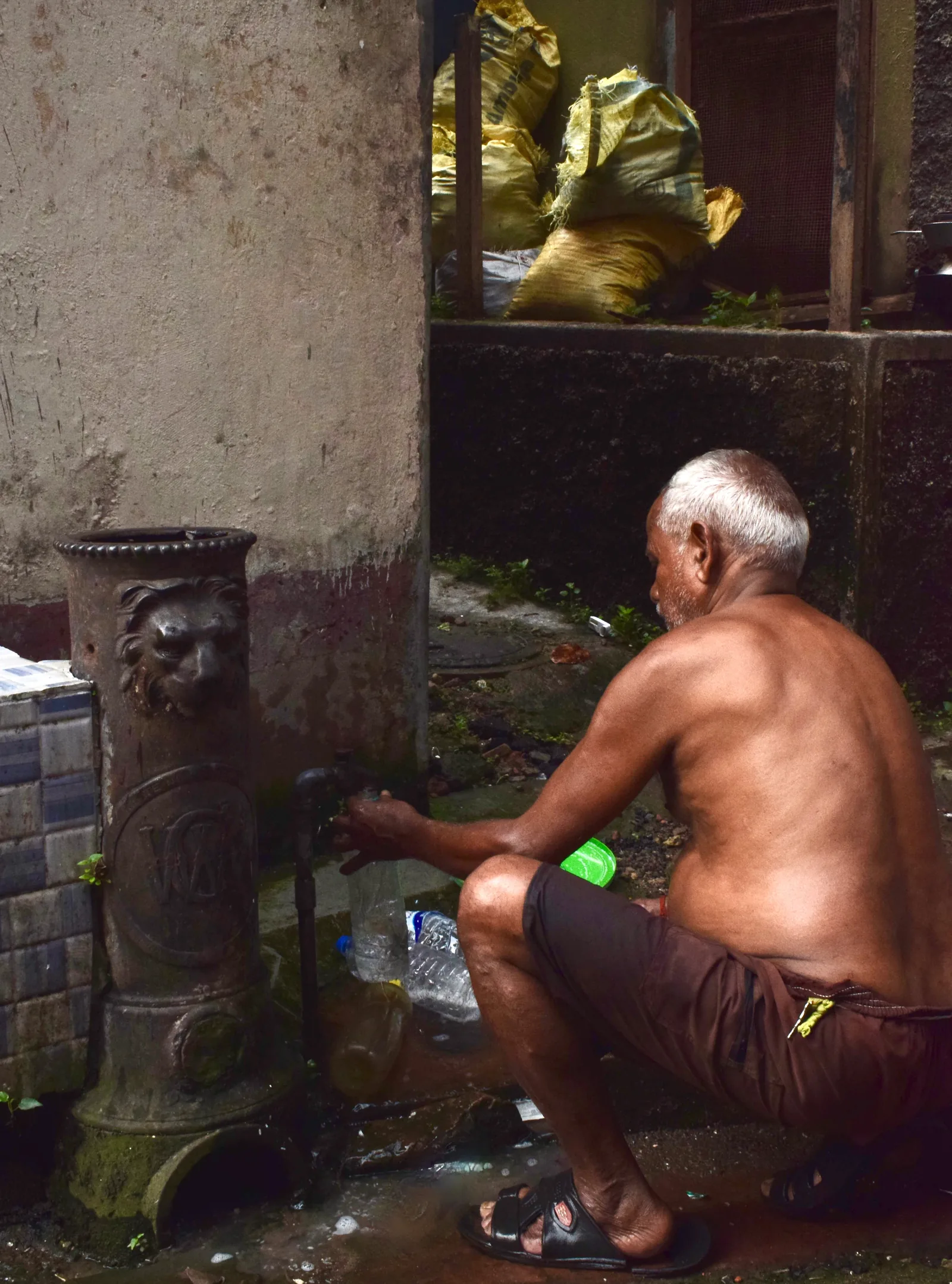
It's bolted into a crumbling wall at roughly waist height, paint flaking from a mane that was once picked out in black and gold: a lion's face, mouth open, where a brass spout used to sit. Someone has balanced a steel bucket beneath it anyway, out of habit more than hope — the fountain hasn't run in years. Children walk past it without a glance on their way to school. An elderly man pauses, rests a hand on the cold iron for a second longer than necessary, and moves on. Singho kol, Bengali calls it. Lion tap. For a hundred years it was the single most important object on this street. Now it is furniture.
A City Without Water of Its Own
For most of its early history, Calcutta drank from wherever it could — ponds, tanks, and the Hooghly itself, all of it unfiltered and, by the standards the British were beginning to take seriously elsewhere in the Empire, dangerous. The fix arrived in stages. A treatment works at Pulta, drawing and filtering river water, began operating sometime between 1864 and 1870; the first pipeline into the city followed in 1868, at a cost the municipal accounts of the day recorded with evident discomfort. For the first time, Calcutta had water it didn't have to fetch from a tank with a bucket and a prayer.
A Greco-Roman Lion for a Bengali Street
What to do with newly piped water was its own design problem, and the answer the municipality settled on was oddly ornate for something meant purely as plumbing: cast-iron pillars, Greco-Roman in style, each one topped with a lion's head with a spout set into its open mouth. They were manufactured in Glasgow by the engineering firm Alley & MacLellan and shipped out to a colonial capital that, whatever else it lacked, was not going to let its street furniture look utilitarian. Many carried an engraved instruction in two languages at once — 'Waste Not, Want Not' in English, আপচয় করো না, অভাব হবে না in Bengali — a small, stern reminder that the water now running free from a lion's mouth was not, in fact, free.
A lion imported from a Glasgow foundry, speaking Bengali about thrift, bolted to a wall in a city it would never fully belong to or fully leave.
The fountains were not received as the straightforward civic gift the municipality intended. Some communities objected that the leather washers fitted inside the taps were made from cow or pig hide, an offence to religious sensibility on more than one side at once. Others simply didn't trust water that arrived through pipes and iron rather than from the river directly — Ganga jol carried a sanctity that a municipal spout, however handsome, could not easily replicate. Adoption, in the end, came less from persuasion than from the plain advantage of water that didn't carry what the river did.
The Survivors
A handful of the grander fountains still stand and are known individually, almost like minor local celebrities. The McDonnell Fountain, put up in 1894 near the Calcutta High Court on Esplanade Row, and the Panioty Fountain of 1898, in what's now Surendra Nath Banerjee Park, are both substantial enough to have survived the century mostly intact. At Jorasanko, one fountain tied into the old fire-water system still stands. Inside Alipore Zoo, a related design swapped the lion for a dolphin's head — most now fitted with plain plastic spouts, the original ironwork kept for its shape rather than its function. The neighbourhood versions, the ones bolted into ordinary walls on ordinary lanes, have fared worse: most spouts are broken, the pipework behind them long disconnected from anything.
What's left of the singho kol is mostly symbolic now — a lion's head that no longer dispenses anything, kept not because the city needs it but because nobody has quite gotten around to removing it. That, in its way, is a very Kolkata kind of survival: not preserved by policy or plaque, just outlasting the reason it was built, because taking it down was never anybody's job and leaving it up never hurt anyone.
Spot the singho kol and dozens of other small heritage details hiding in plain sight on a private walk through North Kolkata.
See the North Kolkata Tour →