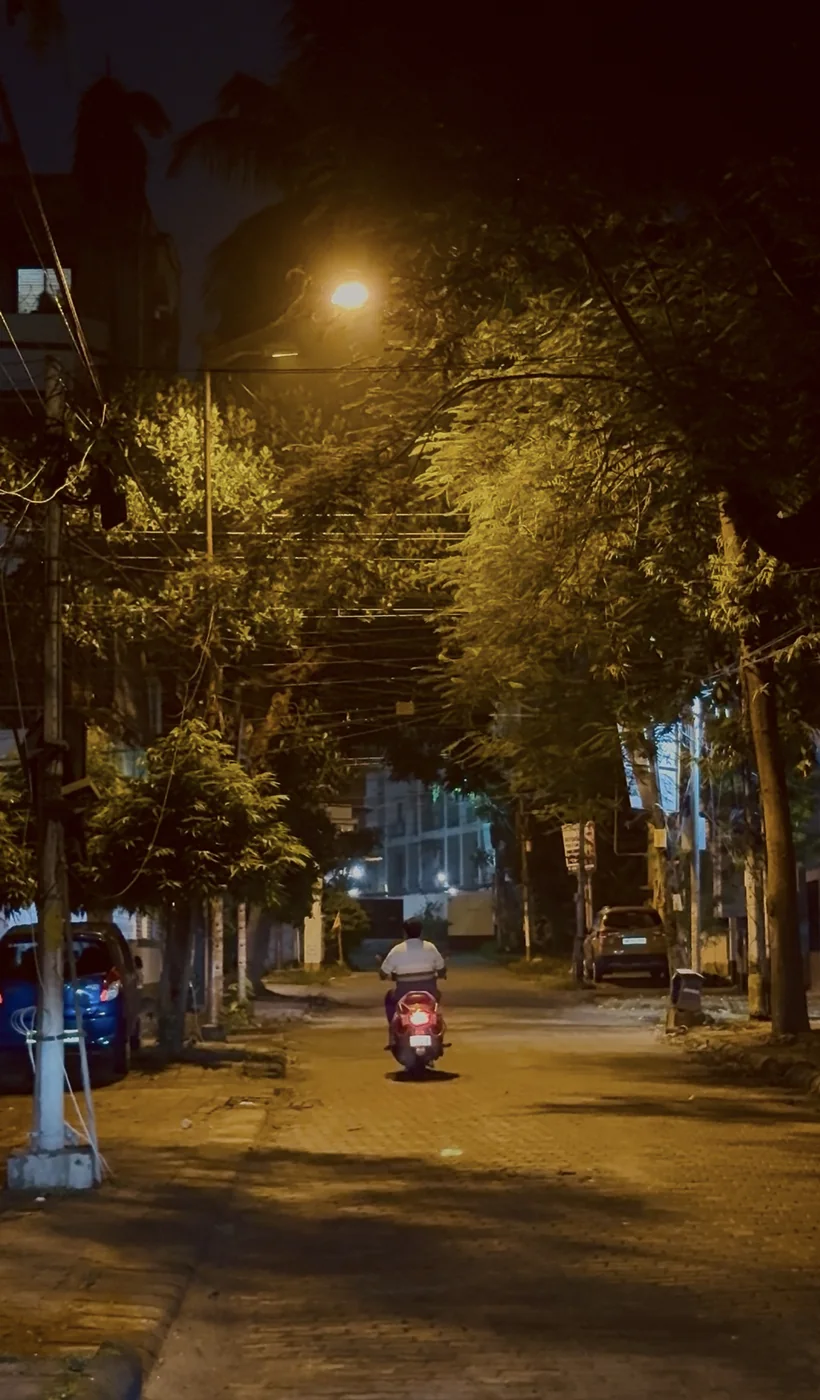
There's a specific minute, just after the sky goes the colour of a bruise, when a Kolkata street stops being lit by the day and starts being lit by itself. A lamppost flickers once, steadies, and throws down a cone of warm, slightly dirty yellow-orange light — not the clean white of a torch, something closer to candlelight scaled up and bottled in glass. Moths find it within the minute. A tea stall under one of these lamps looks, for a few hours every evening, like a scene somebody lit on purpose for a film. In a growing number of neighbourhoods now, that lamp has been swapped for a plain white LED, and the street under it looks like nowhere in particular.
A City That Has Been Lit Four Different Ways
Kolkata's streets have gone through this kind of change before, more than once. By 1857, coal-gas lamp posts already lined the city's major roads — among the earliest gas-lit streets anywhere in Asia. Electric light arrived not long after: a first public demonstration in 1879, then, on 17 April 1899, the Calcutta Electric Supply Corporation switched on a thermal plant on Emambagh Lane that fed the city's first commercial electric supply — power for street lighting, homes, offices, and the tramways all at once, seventeen years after New York and eleven after London. For a stretch of years after that, Kolkata ran gas and electric street lighting side by side, an overlap few cities in the world got to see.
Why the Light Was Always Yellow
The specific amber-yellow most of us grew up under is a sodium-vapour lamp — light produced by exciting sodium gas inside a glass tube, concentrated almost entirely at a single wavelength of about 589 nanometres, which the eye reads as a warm orange-yellow. Cities everywhere settled on it for the same practical reasons Kolkata did: it's highly efficient, and that narrow-band light cuts through mist, smoke and monsoon haze far better than a broader white light does. It was never chosen for atmosphere. The atmosphere was simply what you got, as a side effect, from the most practical streetlamp available for most of the twentieth century.
Nobody installed these lamps to make the evenings look a certain way. The city just happened to spend a hundred years under a colour that, in hindsight, nothing else quite replicates.
The Switch to White
The Kolkata Municipal Corporation's LED pilot replaced a cluster of 400W and 250W sodium-vapour fittings along stretches of S N Banerjee Road, Bidhan Sarani, Narkeldanga Main Road and the roads around Kalighat Temple with 273 LED units — each one drawing roughly half the power of what it replaced, for an estimated 350 megawatt-hours saved every year. The case for the switch is hard to argue with on paper: LEDs last three to five times longer, contain no mercury, and throw a cleaner white light that most traffic studies rate as better for visibility. Pilot projects like this one have since widened into a broader, ongoing citywide rollout, street by street, as the old sodium fittings fail and get replaced rather than repaired.
None of that math has anything to do with colour, and none of it was ever going to stop for the sake of one. A white LED is simply the more sensible lamp. It's also a genuinely different light to live under — flatter, cooler, more like an office ceiling than an evening.
What's disappearing isn't a building or a trade with a clear advocate to defend it — it's a colour, replaced one municipal contract at a time, with nobody specifically responsible for noticing it's gone. A handful of older lanes, slower to get new fittings, still glow amber after dark the way the whole city once did. It won't last forever, and there's no real argument for keeping an inefficient lamp running purely for nostalgia. But it's worth looking up at one of these lampposts while it's still there — not for the light it throws on the street, but for the exact, oddly specific shade of evening it's been quietly manufacturing for a hundred years.
Kolkata after dark, amber lampposts included, is part of what an evening walk through North Kolkata with us can show you.
See the North Kolkata Tour →